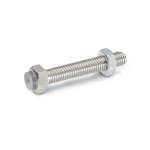
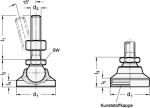
Setting bolts GN 251 can be used as as a firm end stop as well as for support. The version with Polyurethane disk (type BK) functions as damping element or protection for...
Workholding bolts DIN 6321 are inserted into bores for positioning, assisted by the flattened design (type C) to compensate tolerances in the spacing of two bores. Another...show more
The rotary clamping latches GN 516.5 have a closing mechanism which transfers the rotary movement of the operating element resp. socket key into a 90° turn and then into a 6 mm...show more
Hinges GN 128 are produced from drawn weldable profiled steel extrusions. Types ST, STS and MS feature a hinge pin fixed in the lower half of hinge. Type STL with loose steel...show more
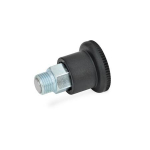
Mini indexing plungers GN 822 are distinguished for their small dimensions. They have been designed for installation in thin walled sheet metal constructions. In type C, the...show more
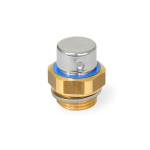
Breather filters GN 882 are used when the air exchange is to be allowed between the inside of the container and the ambient air. The filter function is marked by a blue colour...show more
Silicone buffers GN 256 are used as end stops or setup elements for machine and systems, e.g. for conveyors. The silicone rubber used absorbs vibrations, has a damning effect,...show more
For mounting clamps, the clamping kits GN 511 replace the socket cap screws with hexagonal socket DIN 912. It is used on all clamping points where repeated clamping actions are...show more
The design and handling of the adjustable hand lever GN 604.2 satisfy the high standards of the Ergostyle® product family. Safety hand levers GN 604.2 are used where the...show more
The dimensions d2/ l1 of the stainless steel cylinder head shoulder bolts GN 732.1 permit a use as bearing pin for swing bolts DIN 444, swing bolts GN 1524, swing nuts GN 444.2...
The design of the cranked handles GN 670.2 matches the product family Ergostyle®. Attaching the cranked handle on a shaft using a transverse pin or a set screw is made easier...show more
Spring plungers GN 614.4 are used for locking, as pressing and back-off pins, but also as impact dampers. A tolerance of H7 for the location hole of d1 is recommended.
Precision type swing bolts DIN 444 are mainly used for jigs and fixtures. Produced in a precision version as is required in machine and jig construction, the stated tolerances...show more
Fork joints GN 751 consist of a fork head according DIN 71752 and a pin with axial shaft safety (Type KL and SL) or a snap-on spring pin (Type B). Size d1 = 12 is supplied with...show more
Nuts GN 1580 are certified according to EHEDG guidelines and are therefore ideal for use in hygienic areas. The sealed mounting surface enables components to be mounted without...show more
Stainless steel hinges GN 235 are adjustable in height or width along the slots, depending on the design, and are fastened with hex-head, oval-head or cylinder screws with a low...show more
With stainless steel hinges GN 127 doors and covers can be positioned snugly and in a finely adjusted manner by moving the adjusting bushings. In this way, door gaps can be...show more
The static load of the leveling feet GN GN 343.6 is limited by the load capacity of the ball joint / threaded stud (AISI 303). The static load values in the above table refer to...show more
Toggle clamps GN 820 work according to the toggle principle: lever and clamping bar move in the opposite direction. They require less space for the clamping action. In the...show more
The design of the GN 676 knurled knobs matches the product family Ergostyle®. These knurled knobs are used for manual applications for clamping or pulling. The concave top of...show more
Leveling feet GN 31 with vulcanised rubber (Types B3, B4, C3 and C4) and screw version W feature fewer dead spots owing to their construction method and are also easier to...show more